

Learn Japanese The Easy Way P3 - Beginner Level
Table of links for "Learn Japanese The Easy Way":
part1: Start
part2: Self-Learning Method
part3: Beginner Level
part4: Intermediate Level
part5: Advaned Level
part6: End / Motivation
-----------------------------------------------------------------------------------------------------------------------------
1. Anki
a. Anki is a flashcard software that schedules and spaces out your review over a certain period of time so that you can store those words in your long term memory. Once a card has become "mature" from after correctly guessing each card right 4 times straight, you can say that you've mastered that word for now. It's a good way to know you're making progress and so you don't get lost.

c. Here's a youtube tutorial on how to create an anki deck. Might be necessary to watch more tutorials to get the basics down.
-----------------------------------------------------------------------------------------------------------------------------
2. Hiragana / katakana
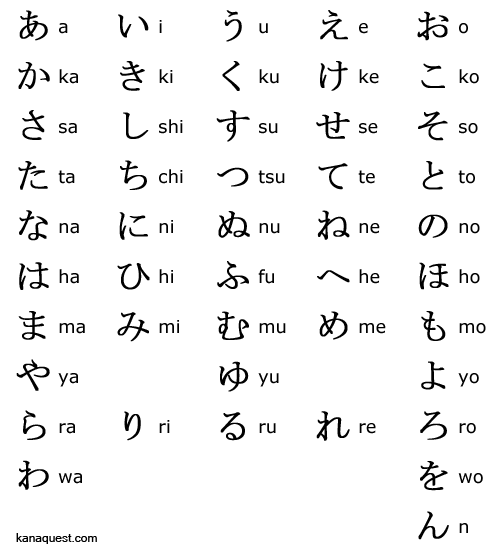
a. These are the basic alphabet of Japanese, containing 46 characters each. Master these before going on to kanji and grammar.
b. Here's an easy way to learn: they basically look like fancy English characters if you bend your imagination.
-Hiragana / ひらがな:
i. い = i = 'i' with the dot at right side
ii. ろ = Ro = resembles a (Ro)cket
iii. の = No = 'n' and 'o' fused together
iv. ら = Ra = looks like a (Ra)bbit
v. お = O = looks like an 'o'
vi. え = e = lower case 'e'
vii. き = ki = car 'keys'
viii. そ = so = backwards 'S' with 'o' at bottom
ix. つ = tsu = 'tsunami' wave going to the right
x. と = to = 'toe' with nail jammed in it
xi. ん = n = fancy 'n'
xii. せ = se = someone 'seated' at steering wheel
i. イ = i = weird shaped 'i'
ii. ク = ku = holding a fancy 'kup'
iii. コ = ko = dead end 'korner' in a maze
iv. サ = sa = horse 'saddle'
v. ス = su = bowl of 'soup' that has a leak
vi. ト = to = 'toe' of a messed up chicken
vii. ユ = yu = 'yu' with the 'y' laying on its left side and the 'u' inside the 'y'
viii. ヨ = yo = one side of a 'yo'-yo
ix. ラ = ra = bowl of 'ramen' with steam floating over the bowl
x. リ = ri = 'ri' rotated 180 degrees to the right
xi. レ = re = 'rear' when seated on a weird seat
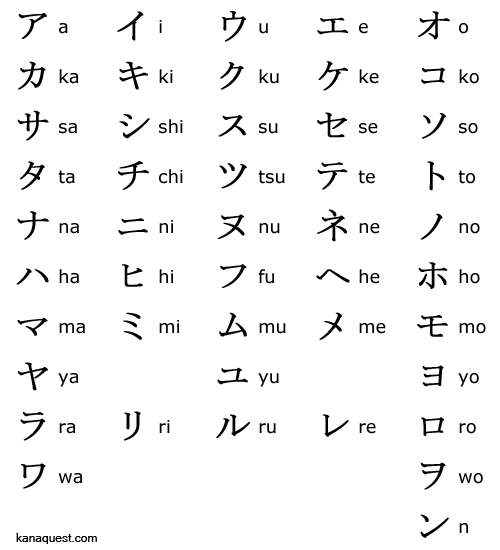
c. Just apply this method to the rest. Here's another helpful vid for hiragana characters.
e. To type hiragana & katakana on your pc, here's a short vid to show you how.
----------------------------------------------------------------------------------------------------------------------------
3. Basic Grammar
-Now that you can read hiragana & katakana, try and learn the basic grammar. From the link above, I've summarized the main points below, but it won't make any sense unless you've at least looked at each of the links listed in each section. After that, only learn more grammar when encountering the unknown so you don't learn useless stuff (to save yourself time). You will see these basic grammar points in almost every sentence.
a. Expressing state-of-being (to be)
ii. じゃない = isn't
iii. じゃなかった = wasn't
b. Introduction to particles
ii. も = also
iii. が = indicates sentence subject (sometimes object). Most of the time, the thing marked with が will end up doing the verb that follows [another link for が].
c. Adjectives
ii. い adjectives = words that end in い are usually adjectives.
d. Verb basics
e. Negative verbs
i. る verbs = drop る and add -ない.
ii. う verbs = replace u-vowel sound with a-vowel equivalent and add ない.
f. Past tense
i. る verbs = drop る and add -た.
ii. Other forms in chart (gets complicated).
g. Particles used with verbs
ii. に = in, to, on
iii. へ = to (only used for destinations)
iv. で = at (used for place of action)
ii. Intransitive = verbs that don't use direct objects [Ex. The book falls].
j. Noun-related particles
i. と = andii. や, とか = lists vague items [etc…things like…stuff like…]
iii. の = possessive particle [My stuff, his stuff, her stuff]
k. Adverbs and sentence-ending particles
ii. よ = indicates certainty
iii. よね = dontcha
-------------------------------------------------------------------------------------------------------------------------------
4. Assuming you've completed the previous steps, you can venture off in anime, music, manga, etc. and start learning from your favorite stuff. Just remember to add those words to anki so you don't forget, and try to accumulate 6000 words and 2136 kanji that you will eventually add if you intend to go this route. Or if you're ready for the next step, then proceed.
------------------------------------------------------------------------------------------------------------------------------
Continue to part 4 - Intermediate Level
0 comments: